Quadruped Walking Gait Tracking: What Engineers Should Verify
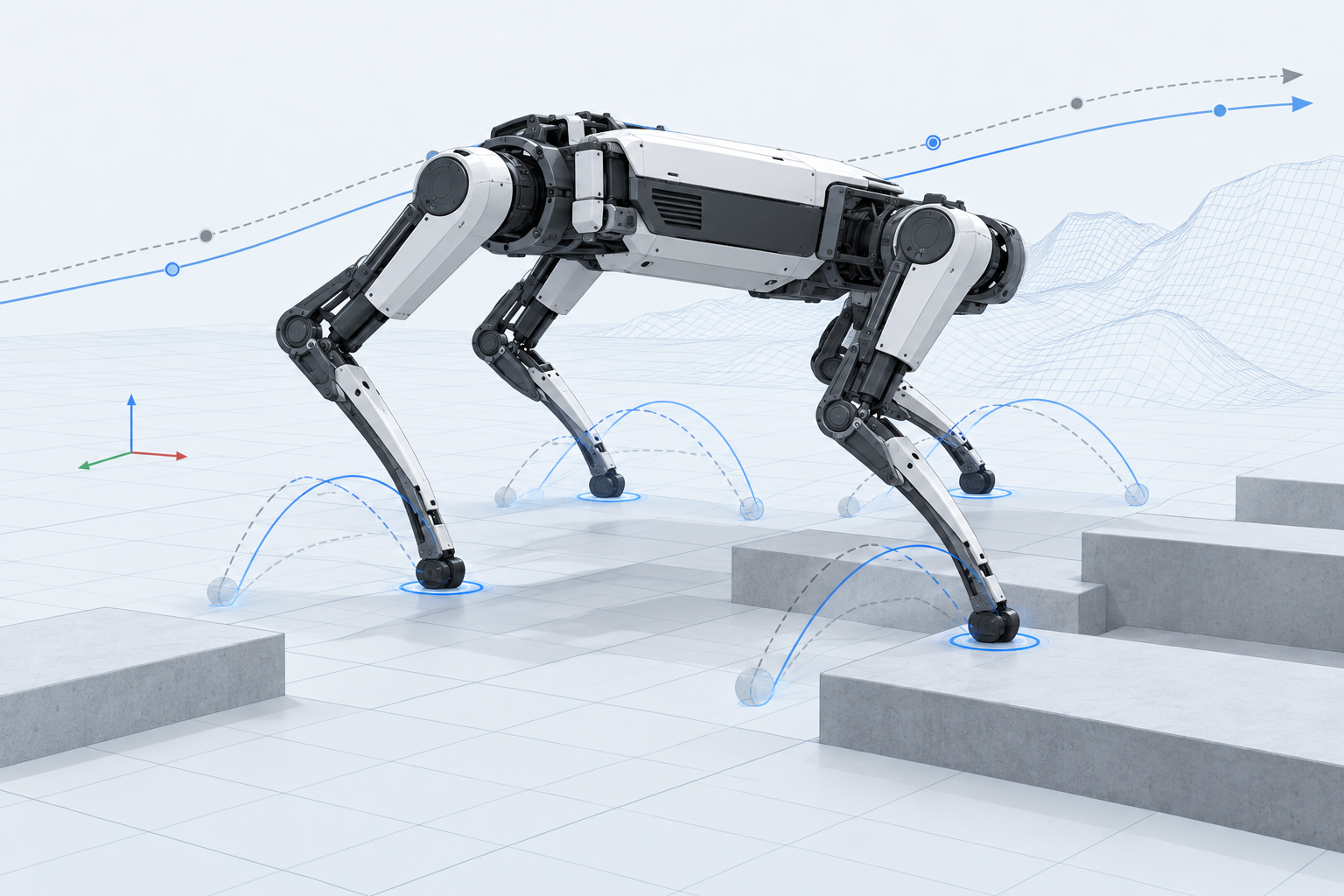
A quadruped walking-gait study invites a practical engineering question: what would you need to reproduce before treating its controller as a useful candidate for your own model? Start with the tracking objective, the operating assumptions, and the evidence behind the reported result, rather than the novelty implied by the title.
The supplied source list includes an article titled Tracking the Walking Gait of a Novel Quadruped Robot ... on the MDPI website. However, the material provided here contains only its abbreviated title, link, and listing date, not the abstract, equations, experimental setup, or results. [1]
That limitation sets the scope of this article. It is not a reconstruction of the paper's controller or a claim that its results have been verified. It is a practical review-to-simulation workflow: what to extract from the full paper, how to turn those details into a controller evaluation, and what to keep explicitly unresolved until supporting evidence is available.
What happened: a research lead, not yet a verified result
The central research lead is the supplied walking-gait tracking article. Its title identifies quadruped locomotion and tracking as its subject, but the abbreviated record does not establish the robot configuration, controller architecture, reference-generation method, or validation procedure. Those details should remain open questions. [1]
The surrounding source list contains several different kinds of research-discovery material. These include a physical AI news page, a robotics paper digest, and a robotics articles and technical guides page. Their supplied titles establish their relevance as discovery resources, not their support for any particular result in the gait-tracking paper. [2][4][5]
Other entries are profile pages titled Dongjun Lee and David D. Fan, plus an institutional listing for Harbin Institute of Technology. Do not infer authorship, collaboration, or affiliation with the target paper from their presence in the same source bundle. No such relationship is established by the supplied records. [3][6][7]
The list also includes a product page titled Unitree As2 EDU Plus Quadruped-Roboter. Treat that entry as a separate product reference. It does not, from the provided material, establish which platform the research used or whether its controller could be transferred to that product. [8]
For an engineering review, the immediate task is therefore evidence collection. Retrieve the full primary article and its supporting material before selecting a controller family, claiming a performance improvement, or scheduling reproduction work around an assumed implementation.
Why this matters for engineers
Turn the title into a testable question
Before reviewing the controller mathematics, write down what you want the study to establish. Is the question about following joint references, placing feet, maintaining a body trajectory, or coordinating a complete walking sequence? Do not allow the word tracking to stand in for an explicit specification.
Ask the paper to identify the commanded quantities, the measured or simulated outputs, and the definition of error. Then ask whether its figures and conclusions address that same definition. If the necessary information is missing, record the gap instead of filling it with a familiar convention from another project.
For your own reproduction, select a primary tracking objective and list any supporting objectives separately. This keeps the evaluation focused without silently discarding constraints that matter to your application.
Separate novelty from suitability
The supplied article title describes the quadruped as novel, but the available record does not explain the claimed novelty. [1] Treat novelty as something to locate and assess in the full text, not as a proxy for controller suitability.
During review, separate questions about the mechanical arrangement from questions about trajectory generation, feedback design, and validation. Ask which contribution the authors actually claim and what evidence supports it. Avoid assigning credit to a control method for an outcome that the paper attributes to another part of the system.
For project planning, define suitability in your own terms: compatible model assumptions, accessible controller inputs, acceptable command requirements, and a reproducible evaluation procedure. Leave each criterion unresolved until it has an identifiable source or a completed test.
Make the evidence boundary visible
Use separate categories for information extracted from the paper, choices introduced by your team, and questions awaiting clarification. Apply those categories to parameters, reference trajectories, controller settings, and simulation conditions.
Keep the distinction visible in the final report. A reproduction attempt with substituted assumptions should be described as such, rather than presented as an exact replication. Likewise, a locally successful simulation should not be described as confirmation of results that were not available for comparison.
Practical workflow: from paper review to a controller candidate
The following workflow is a proposed engineering procedure, not a description of the method used in the supplied article. The article remains the primary source to consult for the actual robot and controller definitions. [1]
Establish an evidence worksheet
Create a worksheet with separate entries for the robot model, walking reference, controller, numerical implementation, and evaluation conditions. For each entry, record the relevant location in the paper or supplement and the information needed to reproduce it.
Use a clear status label such as documented, locally assumed, or unresolved. For example, if an actuator constraint is absent from the available material, mark it unresolved. If your team introduces a constraint for an exploratory run, label that value as a local choice rather than an author-provided parameter.
Do not begin by completing every empty field from habit. First identify which gaps prevent implementation and which merely limit interpretation. Send the blocking questions for clarification, and keep exploratory work separate from any claimed reproduction.
Write the tracking contract
Prepare a compact specification of the controller interface. Define the reference inputs, available feedback, commanded outputs, and any information supplied by the gait generator. Name the coordinate conventions and units in that specification.
Decide whether the evaluation concerns joint motion, foot motion, body motion, or a combination. If several quantities are included, identify the primary objective and describe how the others will be assessed. Do not merge unlike errors into an unexplained aggregate score.
Also state the intended scope of the candidate. For this exercise, keep the deliverable to a controller evaluated in a specified simulation. Treat implementation outside that environment as a separate question requiring separate evidence, rather than an implied extension of the report.
Inspect the reference before tuning feedback
Obtain the reference-generation procedure from the full article if it is available. If it is not, document the substitute procedure and explain that the resulting evaluation is exploratory. Do not silently replace an unavailable walking pattern with a convenient local example.
Inspect reference position, velocity, and any additional signals required by the proposed controller. Check their coordinate definitions and inspect the transitions between walking phases. Where derivative signals are calculated locally, record the calculation method and its settings.
Review the reference against the constraints represented in your model. Ask whether the requested motion respects the joint ranges, command limits, and contact assumptions you have chosen to enforce. Resolve these questions before treating feedback tuning as the next task.
Audit the simulation interface
Trace each reference and feedback signal from its source to its use in the controller. Check joint ordering, sign conventions, units, frame definitions, and any transformations between model and controller coordinates.
Inspect how the simulation represents contact and actuator commands. Record the chosen formulations and settings without implying that they match the paper unless the source establishes that match. Where the paper specifies a different treatment, document the difference explicitly.
Keep numerical settings in the experiment record alongside controller settings. Record the integration configuration, controller update arrangement, initialization procedure, and termination conditions. When a run is repeated, use that record to establish what was held constant and what was deliberately changed.
Implement a reviewable controller candidate
Once the interface is explicit, implement the selected candidate with its internal signals available for inspection. If reproducing a published law, retain the notation-to-code mapping so that each implemented term can be traced to the source description.
For a locally designed candidate, document the purpose of each term without attributing it to the paper. Identify which terms use reference information, which use feedback, and which enforce command constraints. Keep optional features visible rather than burying them inside a single opaque function.
Separate parameter selection from final evaluation. Record how settings were chosen and which simulation cases informed those choices. If settings change during evaluation, preserve the earlier results and label the new run as a revised candidate.
Define the nominal evaluation
Choose a nominal case that you can describe completely. Specify the initial condition, walking reference, model configuration, controller settings, and run termination rule. Keep unsupported numerical choices out of the public-facing article, but include justified project-specific values in the internal experiment record.
Capture the commanded and resulting motion together. Add separate records for tracking error, controller output, and any enforced limit. Where the model exposes contact information, include it in the review rather than relying solely on an animation.
Inspect startup behavior separately from the remainder of the run. If the report excludes an initialization interval from a metric, state that exclusion and show the omitted behavior elsewhere. Do not allow an evaluation convention to conceal a problem the team still needs to understand.
Plan sensitivity cases before interpreting success
Write down the questions that a sensitivity review should answer. Depending on the model and project scope, these might concern initial-condition mismatch, uncertain model parameters, feedback timing, command constraints, or changes to the reference.
Select variations only where you can justify their meaning. Do not label an arbitrary collection of settings as representative of an operating environment. Keep the nominal case intact, change a documented assumption, and explain what question the altered case addresses.
For each run, preserve both the outcome and the conditions. If a candidate does not complete a case, record the termination reason and the preceding signals. Treat an incomplete run as evidence to investigate, not as an entry to remove from the results set.
Review performance alongside command requirements
Choose metrics only after defining the tracking contract. State the variable, coordinate convention, evaluation interval, and treatment of incomplete runs for each reported measure. Include trajectories or diagnostic plots wherever a scalar would hide information relevant to the decision.
Review the controller output alongside the tracking results. Ask whether commands encounter modeled limits, whether the candidate depends on unverified feedback signals, and whether changes in tracking coincide with changes in the modeled contact condition.
Avoid a universal pass label. Instead, use a conclusion tied to the evaluated case: the candidate met, did not meet, or could not be assessed against the stated acceptance criteria. Keep untested conditions outside that conclusion.
Package a simulation report
Structure the report so that another engineer can identify the candidate, rerun the experiment, and locate the limits of the conclusion. Include the source-to-model mapping, local assumptions, reference definition, controller settings, numerical configuration, and evaluation criteria.
Present nominal and sensitivity results with consistent labels. Preserve unsuccessful cases and explain any revisions made after inspecting them. Where evidence is unavailable, state what additional material would be needed to resolve the issue.
Finish with a bounded recommendation. For example, recommend continued simulation development, clarification of a source assumption, or revision of the reference. Do not convert a simulation finding into a claim about physical performance or deployment readiness.
A worked review example without invented results
Consider a team deciding whether to reproduce the supplied walking-gait study. At the outset, the defensible source statement is narrow: the supplied record identifies a paper about tracking the walking gait of a novel quadruped robot. It does not provide the method or results needed to evaluate that claim technically. [1]
The team begins by listing the missing implementation inputs. These include the model definition, gait reference, controller equations, feedback assumptions, command constraints, and evaluation conditions. Each item remains unresolved until the full text or supporting material supplies it.
Suppose the team then chooses to explore its own existing quadruped model while waiting for clarification. Label that work as an independent simulation exercise. Do not call it a reproduction merely because the high-level objective resembles the article title.
For that exercise, prepare the tracking contract and inspect the walking reference before selecting controller settings. Define the acceptance criteria in advance, then evaluate the candidate against those criteria. Keep the results attached to the local model and assumptions.
At the review meeting, present separate conclusions: whether the source is sufficiently documented for reproduction, whether the local candidate meets its simulation criteria, and which questions remain open. This format avoids requiring a favorable research interpretation to justify continued engineering work.
What R&D leads should request at a decision review
Ask for a clear account of what the team knows from the source and what it introduced independently. Require traceability for any claimed correspondence between the published study and the local simulation, especially when the model or reference has been substituted.
Request the experiment record as well as the plots. Review how settings were chosen, which cases were attempted, and how failures or early terminations were handled. If a headline metric is used, ask for its definition before discussing its value.
Keep discovery material in its proper role. The supplied news page, digest, technical articles page, profile pages, institutional listing, and product page may guide further reading, but their supplied records do not substantiate the target paper's controller performance. [2][3][4][5][6][7][8]
Finally, make the next decision explicit. Is the team approving a closer literature review, a reproduction attempt, or further simulation development? Attach the required evidence to that decision rather than treating all progress as a single readiness claim.
Key takeaways
- The supplied article record identifies a quadruped walking-gait tracking topic, but does not expose its controller, model, or results. [1]
- Define the tracked quantities, coordinate conventions, constraints, and acceptance criteria before tuning a candidate.
- Separate source-provided information from local assumptions and unresolved questions.
- Inspect reference signals and simulation interfaces before attributing behavior to the controller.
- Report tracking behavior alongside command requirements, numerical settings, and unsuccessful cases.
- Keep conclusions bounded to the model, candidate, and conditions actually evaluated.
FAQ
What controller does the cited paper use?
The supplied record does not identify the controller architecture. It provides an abbreviated title, a link, and a listing date. Consult the full paper and supporting material before naming its control method, explaining its equations, or describing its tuning procedure. [1]
Does the source bundle establish physical robot validation?
No such validation is established by the supplied material. The article metadata does not describe its evaluation, and the separate quadruped product listing does not establish a connection to the study. Keep simulation evidence and physical validation claims separate until the primary source supports the distinction. [1][8]
What should a team do before attempting reproduction?
Obtain the primary article and available supplements, then extract the model, reference, controller, and evaluation definitions. Mark missing information explicitly. If exploratory simulation begins before those gaps are resolved, label it as local development rather than an exact reproduction of the paper.
What is an appropriate initial deliverable?
For the workflow proposed here, use a controller candidate and a simulation report. Include assumptions, reference definitions, implementation settings, evaluation criteria, diagnostic results, and unresolved questions. State the next engineering action without implying that simulation alone establishes performance outside the evaluated model.
Sources
- Tracking the Walking Gait of a Novel Quadruped Robot ..., MDPI.
- The latest in physical AI, physical-ai-times.com.
- Dongjun Lee, alphaxiv.org.
- Robotics Paper Digest, Changda Tian.
- Robotics articles and technical guides, TechniaHQRobot.
- Harbin Institute of Technology: robotics papers, labs and ranking, roboticscenter.ai.
- David D. Fan, alphaxiv.org.
- Unitree As2 EDU Plus Quadruped-Roboter, eu.robotshop.com.
Want to try this on your own plant model?
Try LabCD free with your first model