Fractional-Order PID Controllers: A Stage-Based Implementation Review
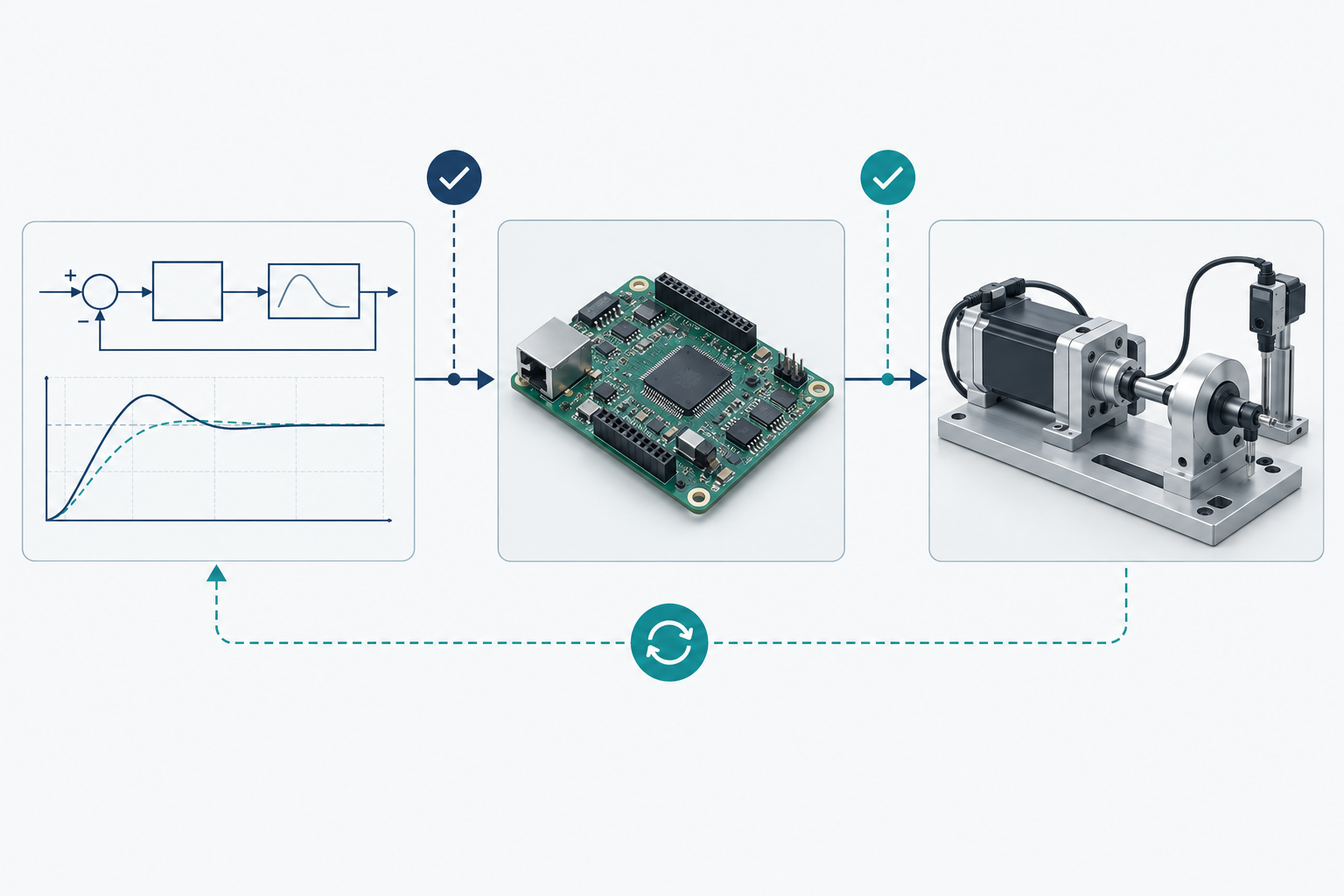
A controller candidate is not ready for an experiment merely because its simulated response looks convincing. Before authorising a test, ask a more demanding question: can the team explain which controller was evaluated, how its implementation was produced, and what evidence supports the next step?
That is the engineering question raised by the title A Stage-Based Framework for Embedded Implementation and Experimental Validation of Fractional-Order PID Controllers. The supplied publication record identifies the article and its publication date as October 26, 2026. [1]
The available material here consists of source titles, dates and links, not the manuscript text. Consequently, this article does not attribute specific stages, algorithms, hardware choices or experimental results to the authors. The workflow below is a proposed engineering review checklist, organised around the implementation and validation scope identified in the title. [1]
What happened
The supplied record identifies a paper explicitly connecting fractional-order PID control with embedded implementation and experimental validation. It also includes links labelled article version notes and article reprints for the same paper. [1][2][3]
Those records establish the subject and provide routes for further inspection. They do not, by themselves, establish the controller formulation, approximation method, target processor, experimental plant, comparison conditions or measured outcomes.
For an R&D lead, the appropriate response is therefore to separate literature discovery from technical acceptance. Treat the paper as a relevant reading candidate, then inspect the manuscript before adopting its framework or relying on any claimed result.
During that inspection, look for an explicit connection between the controller definition, its executable representation and the experiment used to assess it. Ask whether the reporting makes those transitions inspectable rather than leaving the implementation as an unexplained intermediate step.
The version-notes page is a useful place to check the article record, but no revision history is asserted here because its contents were not supplied. Likewise, the reprint listing should not be treated as separate technical corroboration of the paper. [2][3]
Why this matters for practising engineers
For a project review, resist collapsing several acceptance decisions into a single statement that a controller “works.” Instead, require a distinct answer to each question: is the controller specified, is the executable candidate consistent with that specification, and does the experiment address the intended operating conditions?
Make the acceptance object explicit. A mathematical expression, a simulation configuration, a compiled implementation and an experimental record should have their own identifiers. Require the report to show how they relate rather than assuming that a shared controller name is sufficient.
For the fractional-order terms, request the chosen computational representation and the assumptions attached to it. Do not accept an order parameter without also asking how that parameter enters the implementation being reviewed.
Frame the review around decisions the team can act on:
- Which assumptions must hold before this candidate can be evaluated?
- Which implementation choices remain open?
- Which checks must pass before an experiment is authorised?
- Which observations would invalidate the present design rationale?
- Which evidence is missing from the current report?
Use these questions to distinguish a promising design from an adequately documented candidate. Avoid making the review a contest between polished response plots.
For R&D planning, also name the owner of each unresolved decision. A control engineer might own the intended controller behaviour, while another engineer owns the execution configuration. Ask both to approve the handoff criteria rather than allowing responsibility to disappear between model development and implementation.
A practical stage-based review workflow
The following stages are editorial recommendations, not a description of the paper's unpublished details or a reconstruction of its reported methodology. Use them as a template to adapt after reading the primary article. [1]
Define the control problem and the evidence boundary
Begin with the plant model, controlled variable, command signal and permitted actuator behaviour. Specify the operating conditions for which the candidate is being considered. Where the model is provisional, label that uncertainty rather than silently treating the model as an experimental reference.
Write the intended acceptance criteria before selecting a preferred response. Include tracking behaviour, disturbance response and actuator restrictions where they are relevant to the project. If a criterion cannot yet be expressed quantitatively, state the unresolved decision and assign an owner.
Describe the boundary of the proposed evidence. For example, distinguish a nominal simulation assessment from an assessment that deliberately varies model assumptions. Do not describe either as experimental validation.
The exit requirement for this stage should be an agreed problem statement. A reviewer should be able to identify the intended operating envelope and understand which conclusions the planned work is meant to support.
Freeze the controller definition
Record the complete controller specification, including gains, fractional orders, signal conventions and any additional processing. Define the error signal and identify the units used throughout the model and implementation.
Specify the treatment of initial conditions. State how the controller starts, resets and resumes after an interruption. Where a controller operation depends on retained state or signal history, require an explicit description of that handling.
Include actuator limiting and any associated state-management logic in the reviewed definition. If filtering is part of the candidate, record its location and configuration rather than treating it as an incidental plotting or measurement choice.
Keep the design objective separate from the controller parameters. Preserve the tuning rationale, but do not use the tuning objective as evidence that the resulting candidate satisfies every acceptance criterion.
The exit requirement should be an unambiguous controller description. Another engineer should not need to infer missing behaviour from a favourable simulation trace.
Specify the implementation representation
For each fractional-order operation, document the chosen finite computational representation. Record the method, its settings and the domain over which the team intends to assess its suitability.
Keep this representation distinct from the idealised controller expression. If the project uses both a reference model and an implementation-oriented model, label them accordingly and preserve their configurations separately.
Specify coefficient generation, stored states, numerical precision and the execution update rule. If a tool generates coefficients or code, retain the settings and generated artefacts needed to reproduce the candidate.
Do not select representation settings solely because a nominal response appears acceptable. Require a documented assessment against the project's intended signals and operating conditions. Where the assessment exposes a discrepancy, record whether it is accepted, corrected or left unresolved.
The exit requirement should be a reproducible implementation specification. A reviewer should be able to identify what will execute without relying on the controller's symbolic notation alone.
Compare the reference and executable candidates
Create a comparison plan before interpreting differences. Give the reference and executable candidates the same prescribed inputs, initial conditions and configuration wherever that comparison is meaningful.
Inspect controller outputs and relevant internal signals, not only the final plant response. Where differences appear, isolate the implementation choices under review rather than changing several settings and reporting only the final outcome.
Include startup, reset and limiting scenarios if they belong to the intended operating conditions. If a particular scenario is excluded, explain why and avoid implying that it has been checked.
Preserve unsuccessful comparisons as part of the engineering record. Document the discrepancy, the suspected cause, the change made and the subsequent assessment. Do not overwrite the earlier candidate without retaining the relationship between versions.
The exit requirement should be a justified equivalence or discrepancy statement. Avoid declaring agreement without specifying which signals, conditions and acceptance criteria were used.
Review execution assumptions
Define the intended update schedule and document how inputs and outputs are associated with each controller execution. State the assumptions concerning measurement availability, output application and timing irregularities.
Request an implementation resource assessment appropriate to the chosen target. Record what was measured, estimated or left unverified. Do not convert an estimate into a measured execution claim in the summary.
Include memory allocation, coefficient storage, state storage and exceptional-condition handling in the review. If the implementation can encounter invalid inputs or arithmetic exceptions, require an explicit response policy before approving an experiment.
Where execution assumptions have not yet been checked on the intended target, retain that limitation in the release decision. Describe the candidate as ready for the next verification activity, not as already experimentally validated.
The exit requirement should be a clear statement of the execution conditions under which the candidate is approved for further evaluation.
Build the simulation evidence package
Organise simulations around the acceptance criteria rather than around the easiest plots to produce. For each scenario, record the purpose, configuration, observed response and pass or unresolved decision.
Include variations that are relevant to the stated uncertainty boundary. If the project intends to examine measurement disturbances, actuator restrictions or changes in model parameters, define those variations explicitly and preserve their settings.
Separate tuning cases from assessment cases in the report. Explain which scenarios influenced parameter selection and which were used to review the selected candidate afterward.
Inspect the demanded control action alongside the controlled output. Ask whether the response being presented satisfies the actuator conditions defined earlier, rather than judging it from tracking behaviour alone.
The exit requirement should be a reviewable simulation package, including limitations. A strong package should make an unfavourable result as easy to locate as a favourable one.
Prepare the experiment before authorising it
Write the experimental procedure before running the candidate. Identify the apparatus, measurement chain, configuration, initialisation sequence, command profile and recorded signals needed to interpret the test.
Define stop conditions and the permitted operating envelope. Assign responsibility for monitoring the experiment and for deciding whether an unexpected observation requires interruption, repetition or investigation.
Specify how controller configuration and recorded data will be linked. Retain the executable identifier, parameter set and relevant apparatus settings with the test record, rather than relying on a laboratory notebook entry that cannot identify the tested candidate.
If a comparison controller is included, document the comparison conditions and tuning basis. Avoid asserting general superiority from a result obtained under a narrow or unequal test arrangement.
The exit requirement should be authorisation for a defined experiment. It should not be a blanket approval for unspecified conditions or subsequent deployment.
Close the loop between observation and claim
After the experiment, compare observations with the acceptance criteria established before testing. Identify missing channels, interrupted runs and configuration deviations before interpreting the response.
Keep simulation agreement and experimental acceptance as separate conclusions. If measured behaviour differs from the prediction, document the discrepancy before deciding whether to revise the plant model, controller representation or implementation assumptions.
Attach each conclusion to its supporting evidence. A claim about tracking should point to the relevant tracking assessment; a claim about execution should point to execution evidence rather than a plant-output plot.
End with an explicit disposition: accept the candidate for the stated scope, revise it, or gather additional evidence. Preserve unresolved limitations even when the overall project decision is to continue.
Worked review example: preparing a candidate for an experiment
Consider a hypothetical review package containing a fractional-order PID specification, a simulated closed-loop response and an embedded implementation candidate. No plant type, performance result or parameter value is assumed here.
Start by asking whether the simulation and embedded candidate represent the same intended controller. Locate the implementation representation, generated coefficients, update assumptions and initialisation logic. If any of these are missing, return the package for clarification rather than interpreting the response plot as sufficient evidence.
Next, select a prescribed input sequence and compare the reference and implementation-oriented candidates under documented conditions. Record the chosen acceptance rule before examining the difference. If the result is unacceptable, keep the discrepancy visible while investigating it.
Then review limiting and reset behaviour. Require the test procedure to state how these conditions will be introduced and what observations will be recorded. Do not infer their treatment from a nominal tracking case.
Finally, check whether the proposed experiment can answer the project's actual acceptance question. If the question concerns operation across an envelope but the procedure covers only a nominal condition, narrow the intended claim or expand the plan before authorisation.
The review output is not a promised performance improvement. It is a traceable decision about whether the candidate is adequately specified and whether the planned experiment can support the intended conclusion.
Turning the workflow into an R&D decision process
Use stage exits as evidence gates, not as administrative labels. For each gate, ask for the relevant artefact, the acceptance decision, the reviewer and the unresolved issues. Keep the format compact enough that engineers will maintain it.
When a candidate changes, identify which earlier decisions need reconsideration. A revised controller representation should trigger a review of the comparisons that relied on the previous representation. A changed experimental procedure should trigger a review of the claims that procedure is intended to support.
For literature assessment, apply the same discipline to the primary article. Extract its actual stage definitions and reported evidence only after inspecting the manuscript. Compare those details with project requirements without assuming that the paper's experimental scope matches your application. [1]
Use the supplied article-version link when establishing which version was reviewed, while recording only the version information actually available on inspection. [2]
Key takeaways
- The supplied record identifies a paper on stage-based embedded implementation and experimental validation of fractional-order PID controllers, but it does not supply the manuscript or results. [1]
- Treat the workflow above as an engineering review template, not as the authors' reported method.
- Freeze the controller specification and computational representation before interpreting implementation comparisons.
- Keep simulation, execution and experimental evidence separate, then connect each conclusion to the evidence that supports it.
- Authorise a defined experiment with explicit acceptance criteria and stop conditions, rather than granting open-ended approval.
- Preserve limitations and unsuccessful checks so the final report remains useful for subsequent engineering decisions.
FAQ
Does the supplied material establish that fractional-order PID outperforms conventional PID?
No. The supplied record identifies the article's subject but provides no comparative results, test conditions or measured outcomes. No performance advantage can be attributed to the paper from that record alone. [1]
Are the stages in this guide taken from the paper?
No. They are an editorial review workflow aligned with the implementation and experimental-validation scope in the title. The authors' actual framework requires inspection of the manuscript. [1]
What should an engineer request before reviewing an embedded candidate?
Request the controller specification, computational representation, implementation configuration, comparison evidence and intended experimental procedure. Require each artefact to identify its assumptions and unresolved issues.
What should the final validation report claim?
Limit its conclusions to the tested candidate, documented conditions and available evidence. Keep simulation findings distinct from experimental observations, and identify any acceptance questions that remain unanswered.
Sources
- A Stage-Based Framework for Embedded Implementation and Experimental Validation of Fractional-Order PID Controllers, MDPI, October 26, 2026.
- Article Version Notes: A Stage-Based Framework for Embedded Implementation and Experimental Validation of Fractional-Order PID Controllers, MDPI, October 26, 2026.
- Order Article Reprints: A Stage-Based Framework for Embedded Implementation and Experimental Validation of Fractional-Order PID Controllers, MDPI, October 26, 2026.
Want to try this on your own plant model?
Try LabCD free with your first model